

Koonung Heights Uniting Church
Service of Worship at Home
Good Friday – 3 April, 2026 – 10am or whenever possible

You may like to light a candle during your time of worship.
Feel free to text the Peace to other members of the congregation.
Introit: He became poor – (TiS 721)
He became poor that we may be rich, loving the world and leaving his throne;
King of all kings and Lord of all lords, flesh of our flesh and bone of our bone.
Lighting the Christ Candle:
Candle is lit in silence.
Welcome:
Welcome to our Good Friday Tenebrae service. The word ‘Tenebrae’ means darkness in Latin, and this service of deepening darkness mirrors the darkness that came over the world at the crucifixion. As the service unfolds, candles will be extinguished as we remember the final hours of Jesus’ life and the reality of his death.
At the end of the service we will depart in silence without a benediction, because until Easter Sunday, there is simply nothing more to say.
Candle Lighting:
In the beginning, darkness covered the face of the deep. Then God said,
‘Let there be light.’
And there was light. And every day since, the light has come and gone.
The sun has risen and set.
The moon has waxed and waned.
The light is still with us.
In the beginning was the Word, which brought all things into being.
What has come into being through him is life,
the light of all people.
The light shined in the darkness,
and the darkness did not overtake it.
When God made the light, when the light of all people came into the world,
God did not send away the dark.
The darkness remains.
God created the night for dreams and clarity,
an exhaling of the light.
Let us enter this holy darkness
to bear witness to the light of the world
who was extinguished by violence.
Let us worship our Incarnate God.
Bible Reading: Luke 22:47-53
– The Betrayal and Arrest of Jesus
47 While he was still speaking, suddenly a crowd came, and the one called Judas, one of the twelve, was leading them. He approached Jesus to kiss him, 48 but Jesus said to him, “Judas, is it with a kiss that you are betraying the Son of Man?” 49 When those who were around him saw what was coming, they asked, “Lord, should we strike with the sword?” 50 Then one of them struck the slave of the high priest and cut off his right ear. 51 But Jesus said, “No more of this!” And he touched his ear and healed him. 52 Then Jesus said to the chief priests, the officers of the temple police, and the elders who had come for him, “Have you come out with swords and clubs as though I were a rebel?
53 When I was with you day after day in the temple, you did not lay hands on me. But this is your hour and the power of darkness!”
Prayerful Contemplation:
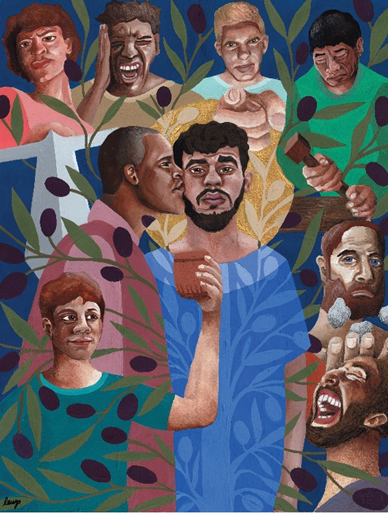
I invite you into a time of prayerful contemplation as we look deeply at the artwork Revealed through Nonviolence. Take a moment and let your eyes move about the image.
Now consider, what stands out to you? Where are your eyes immediately drawn? What pieces of the image did you initially overlook?
Look at the people in this image. What stories and emotions do you imagine for them? What emotions do they invoke in you?
If you were to place yourself in this image, where would you be?
At the heart of this image is Jesus, looking at us. His halo shines revealing the many faces of violence surrounding him. From the foundation of Jesus’ steady posture grows an olive tree. Its branches extend beyond his clothes, reaching out to embrace those around him. Through his nonviolent stance, the truth of a violent world is revealed. In that truth, the good news of peace finds soil in which to take root, to grow and to flourish.
We Sing: The Servant King – (TiS 256)
From heaven you came, helpless babe, entered our world, your glory veiled;
not to be served, but to serve, and give your life that we might live.
This is our God, the Servant King, he calls us now to follow him,
to bring our lives as a daily offering of worship to the Servant King.
There in the garden of tears, my heavy load he chose to bear;
his heart with sorrow was torn, ‘Yet not my will but yours’, he said.
This is our God, the servant King, he calls us now to follow him,
to bring our lives as a daily offering of worship to the Servant King.
Bible Reading: Luke 23:13-25
– Jesus Sentenced to Death
13 Pilate then called together the chief priests, the leaders, and the people 14 and said to them, “You brought me this man as one who was inciting the people, and here I have examined him in your presence and have not found this man guilty of any of your charges against him. 15 Neither has Herod, for he sent him back to us. Indeed, he has done nothing to deserve death. 16 I will therefore have him flogged and release him.”
18 Then they all shouted out together, “Away with this fellow! Release Barabbas for us!” 19 (This was a man who had been put in prison for an insurrection that had taken place in the city and for murder.)
20 Pilate, wanting to release Jesus, addressed them again, 21 but they kept shouting, “Crucify, crucify him!” 22 A third time he said to them, “Why, what evil has he done? I have found in him no ground for the sentence of death; I will therefore have him flogged and then release him.” 23 But they kept urgently demanding with loud shouts that he should be crucified, and their voices prevailed. 24 So Pilate gave his verdict that their demand should be granted.
25 He released the man they asked for, the one who had been put in prison for insurrection and murder, and he handed Jesus over as they wished.
Call to Confession:
In his book ‘What Will You Do With King Jesus?’ James A Harnish writes, ‘is it possible that our world still knows better how to deal with a bandit, a murderer, and insurrectionist than it knows what to do with the Prince of Peace? … Is it possible that we would rather deal with raw power that rides on a stallion than with this one who comes on a donkey, with the weapons of love, patience, suffering and peace? Given the choice, isn’t it possible we would take Barrabas, too?’ [1]
Friends, the passion narrative invites us to place ourselves in the story,
to examine our own complicity in cycles of violence.
And the good news is, we don’t have to do this alone.
The God who made us knows our hearts, knows our flaws,
and knows all our best intentions.
We don’t have to hide. There’s no need to save face.
Let us simply turn to God in prayer with our whole hearts.
Prayer of Confession:
Holy God, we can easily see ourselves
in any number of the people surrounding Jesus in his final days.
We are Judas, betraying what we hold most dear for status, wealth, and security.
We are the soldiers, using our power to maintain the status quo which serves us.
We are the disciples, brandishing our weapons to fight violence with violence,
and we are the high priest’s servant, victims of a world hell-bent on winning.
Prince of Peace, forgive us.
We are Herod, finding our entertainment at the expense of other people’s dignity.
We are Pilate, excusing ourselves from the blame that is rightfully ours.
We are the crowd, foaming at the mouth and demanding blood,
and we are Barabbas, our lives spared while others are crucified.
Prince of Peace, forgive us.
Forgive us, we pray, for the parts we have played.
Set us free from the sin that chokes the world,
threatening to extinguish all that is good and beautiful.
Break the cycles of violence,
step into the machinery of a world fueled by division and disrupt us.
Forgive us, Prince of Peace.
Kyrie eleison. Have mercy on us.
Amen.
Words of Assurance:
Family of faith,
the impossibly good news is that we are forgiven.
No matter what we have or haven’t done,
our God is always waiting
with open arms to receive us.
We Sing: My song is love unknown – (TiS 341)
My song is love unknown, my Saviour’s love to me,
love to the loveless shown, that they might lovely be.
O who am I that for my sake my Lord should take frail flesh, and die?
He came from his blest throne salvation to bestow:
but all made strange, and none the longed-for Christ would know.
But O my friend! my friend indeed, who at my need his life did spend.
Sometimes they strew his way and his sweet praises sing,
resounding all the day hosannas to their King.
Then ‘Crucify!’ is all their breath and for his death they thirst and cry.
Here may I stay and sing, no story so divine;
never was love, dear King, never was grief like thine.
This is my friend, in whose sweet praise, I all my days could gladly spend.
Bible Reading: Luke 23:33-38
33 When they came to the place that is called The Skull, they crucified Jesus there with the criminals, one on his right and one on his left. 34 Then Jesus said, “Father, forgive them, for they do not know what they are doing.” And they cast lots to divide his clothing. 35 And the people stood by watching, but the leaders scoffed at him, saying, “He saved others; let him save himself if he is the Messiah of God, his chosen one!” 36 The soldiers also mocked him, coming up and offering him sour wine 37 and saying, “If you are the King of the Jews, save yourself!” 38 There was also an inscription over him, “This is the King of the Jews.”
Reflection:
Where is the good news on Good Friday? Where do we see glimpses of goodness within an awful, brutal story? Jesus kisses the one who betrays him. He exclaims, “no more!” in the fury of drawn swords, offering healing instead. He uses his final breaths to plead for forgiveness for those who have crucified him. Jesus is stripped of all decency and humanity, yet his actions reveal the good news of a peaceful God. Meanwhile, the actions of others around him – the betrayals, the mocking, the derision, the mob mentality, and the violence – reveal who we are at our worst. The Passion narrative tears down any facade. Everything is revealed in this moment, for better and for worse. The good news is, Jesus’ ministry is not defeated by death—it is only interrupted.
Jesus is on a mission to resist the powers, human and otherwise, that instigate injustice and tolerate brokenness. He speaks for the poor, advocates for release of the imprisoned, grants vision to the blind and champions the oppressed. The readings we have heard today highlight some of Jesus’ most poignant moments of forgiveness and nonviolence as he journeys toward death, and Jesus’ death reveals the heart of a God of love who refuses retaliation in the face of horrific violence.
Judas betrays Jesus, and his emancipatory mission, with a kiss that signals to the authorities: he is the one you seek! He is the one whose ministry resists the human inclination to legitimise the diminishment of society’s most vulnerable through laws and glorified traditions. Consistently, defiantly, furiously – but always non-violently – Jesus challenged those laws, even the Sabbath law, and reframed many traditions whenever those laws and traditions were treated as more important than delivering wholeness, healing, and liberation to shattered human lives.
Jesus’ defiance made him a marked man. The authorities sought his arrest, but feared apprehending him publicly lest the people he fought for rise up in his defence. So, with Judas’ help, they seize him secretly. In the chaos of the moment, forgetting the nonviolence Jesus has modelled, his disciples ready their weapons. One even swings his sword and cuts off the ear of an arresting official. Immediately, Jesus reminds his people that they fight with words, ideas, and vision. To press the point, he touches the wounded officer and heals him. The power of God that Jesus represents shows care even for the oppressor—even as Jesus uses God’s power to overturn systems of oppression.
Dying on the cross, Jesus reinforces his message of nonviolent resistance in the most heartbreaking of ways. As the authorities crucify him for proclaiming and prosecuting the hope of liberation for all God’s people, Jesus asks God to forgive them. To the end, he fights them by loving them.
Our calling is to go and do likewise. To fight consistently, defiantly, furiously and non-violently whenever we encounter brokenness, injustice and oppression. To do otherwise is to betray everything for which Jesus lived and died. For Jesus’ ministry was not defeated by death—it was only interrupted. However it might look today, death does not have the last word.
Amen.
We Sing: Were you there – (TiS 345)
Were you there when they crucified my Lord?
Were you there when they crucified my Lord?
O sometimes it causes me to tremble, tremble, tremble;
were you there when they crucified my Lord?
Were you there when they nailed him to the tree?
Were you there when they nailed him to the tree?
O sometimes it causes me to tremble, tremble, tremble;
were you there when they nailed him to the tree?
Were you there when they pierced him in the side?
Were you there when they pierced him in the side?
O sometimes it causes me to tremble, tremble, tremble;
were you there when they pierced him in the side?
Bible Reading: Luke 23:44-46
– The Death of Jesus
44 It was now about noon, and darkness came over the whole land until three in the afternoon, 45 while the sun’s light failed, and the curtain of the temple was torn in two. 46 Then Jesus, crying out with a loud voice, said, “Father, into your hands I commend my spirit.” Having said this, he breathed his last.
Love and Love and Love Again
If you back a cat into a corner
she’ll arch her back, show her teeth, hiss in your direction.
If you back a human into a corner,
we’ll raise our fists, raise our voices,
throw words of hate in your direction.
But when we backed Jesus into a corner, he said,
Forgive them, for they know not what they do.
He offered grace to the criminal hanging beside him.
He asked forgiveness for those who crucified him.
When we backed Jesus into a corner,
he loved and loved and loved again.
They say it can’t be done, but don’t believe them.
In this world we could try to love and love and love again.

Thanks to all those who have assisted in preparation for this liturgy with encouragement, prayers and conversation. I have also utilised the following resources: Sanctified Art (Tell me something good).
[1] ‘What Will You Do with King Jesus? Pictures of the Kingdom of God in Matthew, by James A Harnish, (The Upper Room, 1986).