

Koonung Heights Uniting Church
Service of Worship at Home
Pentecost 4 – 25 June 2023 – 10am or whenever possible
You may like to light a candle during your time of worship.
Feel free to text the Peace to other members of the congregation.
Introit: “Holy, holy, holy” – (Click on this and skip the ads – words below)
Candle Lighting:
As we come to worship today we light this candle,
as a symbol of the light of Christ,
which cannot be held back by distance,
and which shines in each one of us
no matter where we are.
Amen.

Acknowledgement of Country:
This land is God’s land and God’s Spirit dwells here.
I acknowledge the Wurundjeri WoiWurrung People
of the Kulin nation,
traditional custodians of this land under God.
May we commit ourselves again
to working for justice in this land.
Call to Worship:
We gather
from left and right,
high and low, old and young.
We gather
with questions and certainties,
much faith and little, broken and hurt.

We gather
uncertain and sure,
lost and found, loved and unloved.
We gather together
as all God’s people.
Let us worship.
We Sing: “Here in this place” – (Click on this link and skip the ads – TiS words below)
Prayer of Adoration and Confession:
Creator God,
the colour purple is such a rich one,
sometimes viewed as a royal colour.

It reflects your character:
the richness of your personality
and the depth of the vault of your love,
banked for all people.
Yet, we should not become confused
about the place of wealth,
power, position, and prestige in our societies.
Such things count for everything
as too many of us see it,
yet count for nothing to you.
What matters to you
and what should matter to us
is the equal status that all people
have within the affections of your love.
Merciful God,
forgive us when our words,
actions, or lack of action,
withhold Your Love from others.
Forgive us when we contribute to
inequality in the world.
Forgive us when we live
as if the attainment of status is our top priority.
Forgive us when we fail to see the whole person
behind the labels we too often engineer for them.
Forgive us for not doing enough
to lift people out of the marginalised space
they so often find themselves in.
Forgive us, God,
and let us know your mercy and enduring love
as we strive to do better.
Amen.
Words of Assurance:
Brothers and sisters, listen and remember –
Christ came to give us new life,
to redeem and heal our brokenness.
We are made whole through his boundless love.
This is indeed good news.
Thanks be to God.
The Peace:
The peace of Christ has been given to us,
not as a gift of the world which will pass away,
but as a gift from heaven which is eternal.
The peace of Christ be with you …
and also with you.
We Listen: UCA 46th Anniversary President’s message – (Click on this link to view)
A Time for All:
We have just listened to the President’s message for the 46th Anniversary of the Uniting Church. Back on 22 June 1977, three Australian Christian denominations joined together to form the Uniting Church in Australia. As we celebrate our anniversary, we have a chance to remember the joy of the occasion, to recall the gifts and ministry of those who came before us, and to look ahead for what God might be calling us to now.
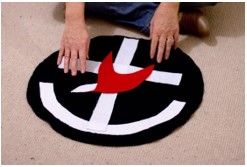
Let us remind ourselves of what the Uniting Church stands for as we tell a story. I might need some help for this.
So … what does this look like? Yes, it’s a black circle. Well the person who first told this story said that this is like a darkened earth – a bit like we might see in photos where the earth is in shadow.
Now this makes a difference doesn’t it. What do think it looks like now? Maybe a bit like a smiley face. Either way it certainly looks brighter now. If it’s not a smiley face what might it be … a bowl … the letter ‘u’?
If we look at it now it might look like something else to us. Maybe an anchor or a boat, and it could be all of those things … but if we add one more piece to the logo what does it look like then? It looks a strikingly like and anchor now … or perhaps a boat without a sail. This is pretty good, but it needs something more.
I think the red makes all the difference … it brings it to life! So what is this. Yes, it’s a bird, not just any bird but a dove, a sign of the Spirit, and red like Pentecost. The red dove is flying, not resting. Not sitting still, but continuing to move forward. I think it’s also a little like a flame … a flame that dances and warms and has the power to ignite something more.
This familiar logo has three colours representing the three churches that formed the Uniting Church. We see that the darkened earth has received the light of the cross. The ‘u’ shape stands for the Uniting Church but also helps for a boat or an anchor, early symbols of the church. The red dove expresses the movement of the Spirit, and just like it brings the logo to life, it is the Spirit that brings the church to life.
Let us pray:
Amazing, loving God,
We thank you for the Uniting Church
and for the hope and vision that accompanied its birth.
We ask that we listen to the Spirit’s prompting
so that we may best be the church you would have us be.
Continue to journey with us as we bravely step into the future.
Amen.
We Sing: “I am the church” – (Click on this link and skip the ads – TiS words below)

Bible Reading: Acts 16:11-19
– The Conversion of Lydia
11 We therefore set sail from Troas and took a straight course to Samothrace, the following day to Neapolis, 12 and from there to Philippi, which is a leading city of the district of Macedonia and a Roman colony. We remained in this city for some days. 13 On the Sabbath day we went outside the gate by the river, where we supposed there was a place of prayer, and we sat down and spoke to the women who had gathered there. 14 A certain woman named Lydia, a worshiper of God, was listening to us; she was from the city of Thyatira and a dealer in purple cloth. The Lord opened her heart to listen eagerly to what was said by Paul. 15 When she and her household were baptized, she urged us, saying, “If you have judged me to be faithful to the Lord, come and stay at my home.” And she prevailed upon us.
Paul and Silas in Prison
16 One day as we were going to the place of prayer, we met a female slave who had a spirit of divination and brought her owners a great deal of money by fortune-telling. 17 While she followed Paul and us, she would cry out, “These men are slaves of the Most High God, who proclaim to you the way of salvation.” 18 She kept doing this for many days. But Paul, very much annoyed, turned and said to the spirit, “I order you in the name of Jesus Christ to come out of her.” And it came out that very hour.
19 But when her owners saw that their hope of making money was gone, they seized Paul and Silas and dragged them into the marketplace before the authorities.
They were very different, the two women in this story:
one with a name, one anonymous;
one well off, one poor;
one who earned money for her family,
one who earned money for her owners;
one who made her own decisions, one with no choices;
one who was free, one who was a slave.
And the named one met Paul by the river,
and Paul baptised her and her household
and went to stay at her home.
And the unnamed one met Paul one day, on his way to the river
and Paul ordered a spirit to come out of her
and left her, now useless to her owners, alone.
This is a story from the early church:
a story about women and their place within it;
a story about welcome and abandonment;
a story about status and powerlessness and power.
I wonder what Jesus would make of this story?
I wonder how history interprets this story?
I wonder what questions this story raises for us and our churches today?
I wonder.

Reflection:
The New Testament text for this week features two women, both of whom we might say are ‘in business’. But it is here that the parallels between the circumstances of these women end, and it becomes more a story of contrasting fortunes and outcomes. The first woman we meet, Lydia, is a well-known character – her name is remembered and her story is often told today. In contrast, the second woman we meet is a slave girl, unnamed, and vanishing from memory after these few short verses. The stories of these women also provide an insight into the way that we treat people, even within the church, and how that is often dependent on their social status or our personal prejudice.
As you know, earlier this week I had a couple of days of study leave, spending time with some female ministry colleagues in Inverloch. One of the things we were discussing was the stories that had come forward about inappropriate behaviour by a parliamentary senator towards female colleagues. Someone commented that when she first heard Lydia Thorpe’s complaints she was dismissive of them because Lydia rubs her up the wrong way. But then hearing the reality spoken by someone else caused her to think about whether her judgement of Lydia had caused her not to listen as deeply as she could have. She felt shocked that her judgement and assumptions had influenced her reaction … but we know that this can be a deeply human response. It’s easy for our biases, or the lenses through which we view the world, to colour the welcome and hospitality that we can offer to others.
It is Paul’s travelling ministry to start new Christian communities which provides the context for these contrasting stories of Lydia and the unnamed enslaved girl. In the verses before the text we have read this morning, Paul has a vision about a man pleading with him to come and help them (you can read this in Acts 16:9). Consequently, Luke narrates how Paul, Silas and others travel to Macedonia. The description of the journey is significant because the community in Macedonia becomes the first church founded by Paul in western Europe. But when Paul and the others arrive, instead of meeting a man, they meet Lydia.
Philippi, in the district of Macedonia, was a diverse city in the Roman Empire, a city that was not predominantly Jewish. This meant that Paul and his companions needed to go outside the city walls to find a place of prayer. Often makeshift synagogues were beside rivers, but the fact that Paul talks to women when he arrives, indicates that there was not a quorum of ten Jewish males needed for worship.
Lydia is a well-known character. She is a successful businesswoman. How well-off she is we do not know for sure, but being a producer of the sought after purple fabric often used in the Roman toga, she would have been in contact with wealthy people and certainly financially comfortable. She also has her own household … no small thing for a woman in those days. She was likely a mover and shaker and possibly something of a business mogul. Lydia was a hard worker – perhaps hands on in the manufacturing work she did and also growing her business through sales. Lydia was not ignorant of the stories of God for we are told that she was a worshipper of God, indicating she was not Jewish but possibly exploring things of faith. Paul shows up, and we hear that her heart is opened to what she hears about Jesus. She is converted, she and her household are baptised, and she becomes the first named convert in Western Europe. Significant too, is the fact that she is a woman, and she becomes a leader in the church in Philippi.

In contrast to Lydia, the woman in the second half of the story is not named. She is also ‘in business’, yet is being used as an asset by others. In other words, she was a slave: not free, but a captive – a captive, not only to the evil spirit controlling her, but to the men who viewed her as a commodity and not a person. The spirit that possesses her gives her the ability to tell fortunes, and allows those who own her to use that power to make money.
It appears that this enslaved girl is persistent in following Paul and Silas – she calls out to the crowds about them – much to their annoyance. Paul does not seem to care about the girl herself, and while he commands the spirit to come out of her, this is not because she is suffering but because he is irritated. This action has consequences … and they are not all good.
This story of the unnamed slave girl, and it’s outcome, are concerning. This woman was certainly a victim. Maybe she was ill. We don’t know this for sure, but often in the Bible the description of the presence of some sort of spirit signifies what we would call illness today. Certainly as a slave she was not free to make her own decisions, or build a fortune or life for herself. She was controlled by those who owned her. And while we don’t know what happens to the slave girl, it is possible that her life has been ruined as after her encounter with Paul, she has lost the skill that has made her useful. Of course, maybe she ends up finding a welcome in the church where Lydia is a leader.
When we think of Jesus and how he taught and healed, his message was all about seeking the best for people and releasing them into the freedom of opportunity that God’s new life promises. This is also the foundational vocation Jesus provides for those who follow as his disciples – that they work to grant all the right to freedom. But the way this story presents itself does not paint Paul, nor indeed the early church, in a good light, for this woman is not treated well. She is presented as a problem to Paul who does not see her in the image of the ‘whole person’. The contrast with Lydia is really stark … the wealthier, independent woman who provides hospitality becomes a leader of the church, and the truth-telling, enslaved girl is forgotten. If only we heard also how the early church might have welcomed her and found new employment for her.
The Gospel is meant to be the tool that helps us confront the problem of marginalisation, but we don’t see that here. And maybe this is the lesson for each of us. It is easy to stray from the world-changing message of Jesus. It is easy to forget that the last shall be first. It is easy to continue to marginalise others because of our own biases and insecurities. It is easy to turn away or speak abruptly when we are irritated.
As people of faith both in and outside of the church community, we need to be conscious of how we respond to those who are on the margins. We need to pay attention to what they say and deeply listen. We need to be conscious that our actions are welcoming and inclusive. We need to remember that they, too, are God’s beloved children. And in all our actions, we need to be wary about extending divisions within our church and society, divisions that treat different classes of people differently, for this only serves to extend the inequality in our world.
May the example of Jesus guide us, and the Holy Spirit encourage us in our efforts.
Amen.
We Sing: “A New Commandment” – (Click on this link and skip the ads – TIS words below)

Prayer for Others (prepared by Harriet Ziegler)
Living, loving God, on this anniversary Sunday celebrating our Uniting Church, we would be like Lydia and the slave girl in the story of Acts. We would have a trusting heart and proclaim you in our words and in our deeds and in our prayers.
We hold before you the Uniting Church in Australia – formed 46 years ago with hearts full of hope and courage. We pray for all the people whose lives have been transformed by the faith and friendship they have found through Uniting Church congregations, camps, fellowship groups, youth conferences, the Aboriginal and Islander Christian Congress and more. We pray for the leaders in every Council of the church –our own congregation, the Presbytery, the Synod and the Assembly. May all the leaders – clergy and laity – have the good of all people and of the Gospel in their hearts.
And we pray too for those whom the Uniting Church has failed – those who have felt disappointed by various decisions, who have been hurt by uncaring structures and actions, those who feel their talents and gifts have not been used, those who have been sent away from your generous table for reasons they do not understand. May they find peace, may they find You alive in them again.
We pray for the people involved in the world in your name – the chaplains, the lay people propelled by their faith into emergency services, medicine, nursing, allied health, teaching, social work, public service. Wherever people of faith go about your business, we pray they will know your strengthening presence.
We pray particularly in this moment for our own congregation as we look for ways to live out our faith in these times. May we be salt and light in this world that needs both. We pray too for individuals of this congregation whose needs are known to us, and for those in our own families and friendship circles. In this time of silence, hear those prayers we carry in our hearts.
(silence)
We are the Uniting Church in Australia, and so we pray not only for our church but also for Australia. Especially we pray that the debate about the Voice to Parliament may be respectful and truthful. We pray for all in our nation who have the chance to make our country better – our Parliamentarians, our judges, our public servants, our journalists. May truth and respect guide them always.
Within our nation and the world are countless numbers of people who are in need – the hungry, the homeless, the dispossessed, the unemployed, the sick, the lonely, the grieving. We lift them to you.
We pray for this beautiful and devastated world. Devastated by war, by climate change, by the widening gap between rich and poor. May we not only pray but may we also work for change.
God of the church, of the nation, of the world, God of our lives, we give thanks that you hear us as we pray all our prayers, and this prayer taught to us by Jesus:
Our Father in heaven, hallowed be your name;
Your kingdom come, your will be done on earth as it is in heaven.
Give us this day our daily bread and forgive us our sins
as we forgive those who sin against us.
Save us from the time of trial and deliver us from evil.
For the Kingdom, the power, and the glory are yours now and forever.
Amen.
We Sing: “A Touching Place” – (Click on this link and skip the ads – TIS words below)

Blessing:
As we leave our time of worship
may we go in a spirit of inclusion,
mindful of those we admire and those we scorn.
May our hearts be open enough
to know this is not God’s way,
and that each beloved child of God is of equal worth.
Let God guide our actions.
Let Jesus remind us why,
and may the Spirit keep our hearts open to all we meet,
this day and every day.
Amen.

Thanks to all those who have assisted in preparation for this liturgy with encouragement, prayers and conversation. I have also utilised the following resources:- Spill the Beans (Issue 47), The Women’s Lectionary: Preaching The Women Of The Bible Throughout The Year (Ashley M Wilcox) and Fig Tree Worship.